
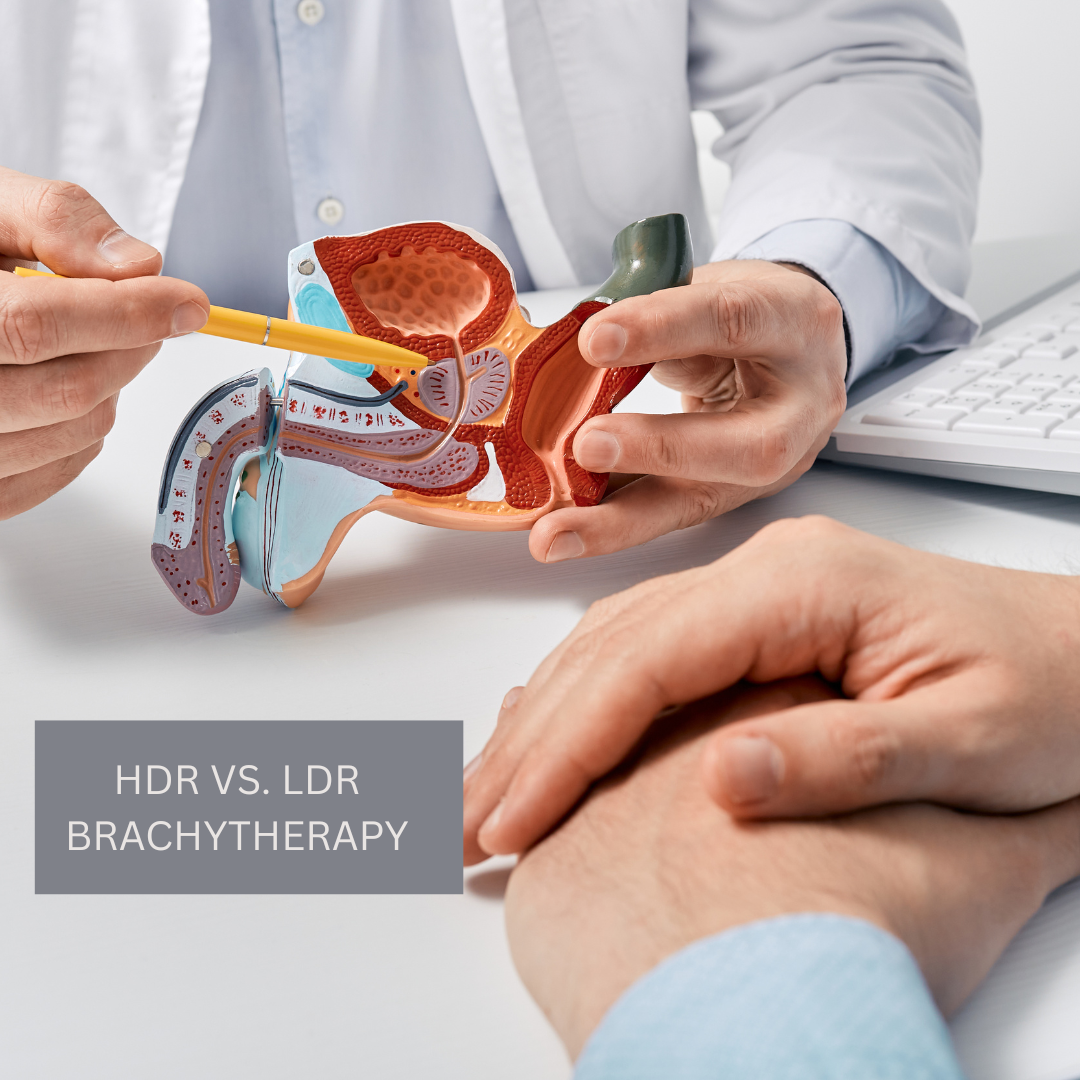
When diagnosed with prostate cancer, many men are faced with an overwhelming number of treatment choices — including active surveillance, surgery, external beam radiation therapy, and brachytherapy.
Among radiation treatment options, prostate brachytherapy offers a highly targeted approach by placing radiation directly inside the prostate gland. This allows physicians to deliver radiation precisely to cancer cells while minimizing exposure to surrounding healthy tissues.
Two primary forms of prostate brachytherapy are:
- High-Dose-Rate (HDR) brachytherapy
- Low-Dose-Rate (LDR) brachytherapy, also known as prostate seed implant
Although both treatments use internal radiation to treat prostate cancer, the way radiation is delivered, the equipment required, and the treatment experience for patients are significantly different.
Understanding these differences can help men make a more informed decision when discussing prostate cancer treatment options with their physician.
What Is Prostate Brachytherapy?
Brachytherapy is a form of internal radiation therapy where radioactive material is placed directly inside or near the prostate. Because the radiation source is positioned close to the cancer cells, brachytherapy allows physicians to deliver an effective dose of radiation while limiting exposure to nearby organs such as the bladder and rectum.
For appropriately selected patients with localized prostate cancer, brachytherapy has demonstrated excellent cancer control rates and remains an important treatment option.
The two main types of prostate brachytherapy are LDR and HDR.
What Is LDR Brachytherapy (Prostate Seed Implants)?
Low-Dose-Rate (LDR) brachytherapy uses tiny radioactive seeds that are permanently implanted inside the prostate. These seeds slowly release radiation over time, gradually targeting prostate cancer cells.
During the procedure, a physician uses ultrasound guidance to carefully place the seeds throughout the prostate. The radiation dose is delivered continuously over weeks and months as the seeds naturally decay.
Potential benefits of LDR brachytherapy include:
- A single outpatient treatment
- Typically completed in less than one hour
- No need for multiple radiation treatment visits
- Decades of clinical research and long-term outcomes data
- Direct radiation delivery to the prostate
- Ability to adjust treatment planning based on anatomy
One unique aspect of LDR brachytherapy is that the success of the treatment is highly dependent on physician experience, precision, and technical skill. Proper seed placement and treatment planning are critical components of achieving optimal outcomes.
What Is HDR Brachytherapy?
High-Dose-Rate (HDR) brachytherapy uses temporary catheters placed inside the prostate. A high-energy radiation source is delivered through these catheters to provide a concentrated dose of radiation before being removed.
Unlike LDR brachytherapy, no radioactive material remains inside the patient after treatment.
Potential benefits of HDR brachytherapy include:
- Precise radiation dose delivery
- No permanent radioactive implants
- Ability to adjust treatment planning based on anatomy
- Reduced radiation exposure after treatment
HDR brachytherapy is commonly performed at specialized radiation oncology centers and may involve multiple treatment sessions depending on the patient’s treatment plan.
HDR vs. LDR Brachytherapy: Key Differences
Radiation Delivery
LDR Brachytherapy
- Radioactive seeds are permanently implanted into the prostate.
- Radiation is delivered slowly over time.
- The prolonged radiation delivery may provide theoretical radiobiologic advantages for prostate cancer, which typically grows more slowly than many other cancers.
HDR Brachytherapy
- A temporary radioactive source delivers a concentrated radiation dose.
- The radiation source is controlled through a remote afterloading system.
Treatment Experience
For many patients, one of the biggest differences is the treatment process.
LDR brachytherapy:
- Typically performed as a single procedure
- Often completed in approximately 30–60 minutes
- Patients generally return home the same day
HDR brachytherapy:
- May require multiple treatment sessions
- Each visit may involve catheter placement, treatment planning, radiation delivery, and removal of the catheters
- Treatment sessions may take several hours
Equipment and Facility Requirements
LDR and HDR brachytherapy also differ in the resources required to perform them.
LDR brachytherapy:
- Does not require a dedicated radiation treatment vault
- Relies heavily on physician expertise and technical precision
HDR brachytherapy:
- Requires a specialized shielded treatment vault
- Requires a remote afterloader system and significant facility investment
Both treatments require appropriate licensing and safety protocols for handling radioactive materials.
Why Is HDR Brachytherapy More Common?
Many patients assume HDR must be superior because it is newer technology and more widely available at major cancer centers. However, availability does not always mean one treatment is universally better than another.
HDR brachytherapy has become more common because it integrates well into modern radiation oncology workflows and can be standardized across treatment centers.
LDR brachytherapy, on the other hand, requires significant physician expertise. The procedure is highly dependent on accurate seed placement and treatment planning, which means experience matters greatly.
Because fewer physicians receive extensive training in LDR brachytherapy, access to highly experienced LDR specialists can be more limited.
For patients, the important question is not simply whether a treatment uses newer technology — but whether the physician performing the treatment has the expertise and experience necessary to achieve the best possible outcome.
Choosing the Right Prostate Cancer Treatment
The best prostate cancer treatment depends on many individual factors, including:
- Prostate size and anatomy
- PSA level
- Cancer stage and grade
- Overall health
- Previous treatments
- Personal preferences
There is no single treatment approach that is right for every man.
Both HDR and LDR brachytherapy are valuable treatment options, and the most important factors are selecting the appropriate therapy and working with an experienced prostate cancer specialist.
At the Prostate Cancer Institute of America, our goal is to help men understand all available treatment options and make informed decisions based on evidence, experience, and individualized care.
“When considering prostate cancer treatment, patients should look beyond the technology and ask the most important question: Which treatment — performed by which expert — offers the best option for my specific situation?” Dr. Ajay Bhatnagar
