
Interventional Oncology: The Future of Precision Prostate Cancer Care Starts With Modern Brachytherapy
By Dr. Ajay Bhatnagar
On World Brachytherapy Day, I believe it is time to rethink how we talk about prostate cancer treatment.
For too long, Low Dose Rate (LDR) Brachytherapy has been viewed through the lens of the past — often described as an older or outdated therapy. But that perception does not reflect the reality of modern medicine.
Today’s LDR Brachytherapy represents one of the most precise, personalized, and technologically advanced approaches available for treating prostate cancer. It is not yesterday’s treatment. It is a form of Interventional Oncology — a discipline focused on delivering highly targeted, minimally invasive cancer treatments directly where they are needed.
The future of cancer care is not simply about developing more technology. It is about using the right technology for the right patient at the right time.
Redefining Brachytherapy as Interventional Oncology
Interventional Oncology is changing the way we think about cancer treatment. Similar to how cardiology evolved from broad medical management into highly targeted interventions such as stents and catheter-based therapies, oncology is moving toward more precise, localized approaches.
Brachytherapy embodies this philosophy.
Instead of treating large areas of tissue from outside the body, LDR Brachytherapy allows us to place radioactive sources directly inside or immediately adjacent to the tumor-bearing region. This creates an exceptionally high dose of radiation where it is needed while minimizing exposure to surrounding healthy tissues.
This is precision medicine in action.
Rather than viewing brachytherapy as a separate or outdated radiation technique, we should recognize it as a cornerstone of modern Interventional Oncology.
The Evidence Supports Its Continued Role
Despite being one of the most conformal forms of radiation therapy, LDR Brachytherapy has become significantly underutilized in the United States. This decline has unfortunately contributed to misconceptions that the treatment is obsolete.
The scientific evidence tells a different story.
Modern studies continue to demonstrate the effectiveness of LDR Brachytherapy across a broad range of prostate cancer scenarios — including:
- Intermediate-risk prostate cancer
- High-risk prostate cancer as part of a comprehensive treatment approach
- Salvage treatment for selected patients experiencing recurrence after previous radiation therapy
When performed by experienced specialists using contemporary technology, LDR Brachytherapy remains an important and highly effective option for many men.
Modern Technology Has Transformed Brachytherapy
The brachytherapy performed today is dramatically different from the procedures performed decades ago.
Advancements including:
- Real-time treatment planning
- Advanced dosimetry software
- Improved imaging guidance
- MRI fusion technology
- More sophisticated patient selection
have transformed LDR Brachytherapy into a highly precise intervention.
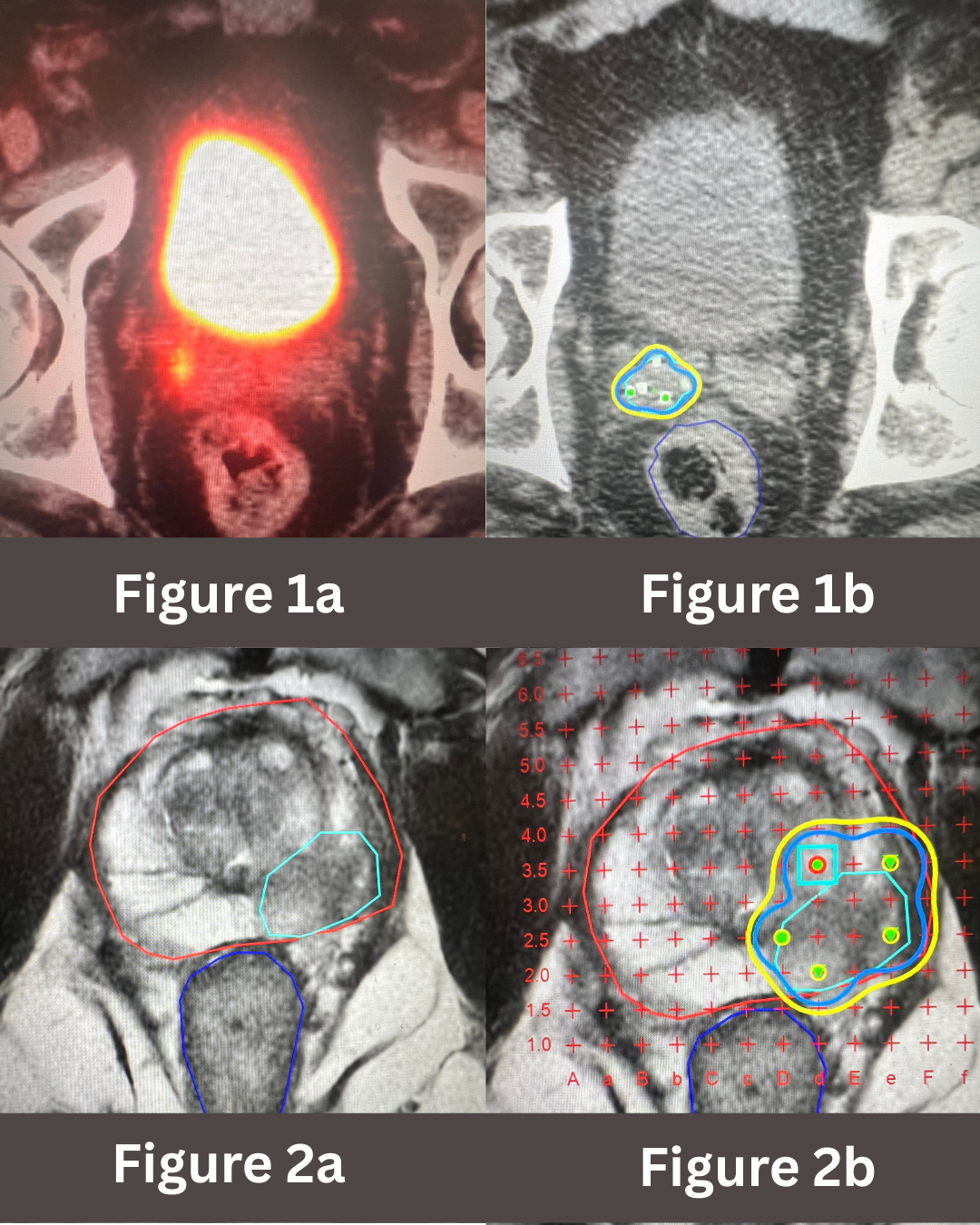
The images accompanying this article demonstrate what modern brachytherapy can achieve:
Figure 1: A patient with an isolated right seminal vesicle recurrence following previous IMRT treatment who was successfully treated with LDR Brachytherapy.
Figure 2: MRI fusion technology allowing precise visualization and targeting during LDR Brachytherapy treatment planning.
These advances allow us to approach challenging cases with a level of precision that was not possible in the past.
The Physics of Radiation Still Matters
As medicine continues to evolve, new technologies will continue to emerge. Innovation is essential. But innovation should not mean abandoning treatments that have demonstrated value.
The fundamental physics of radiation delivery still matters.
Different radiation approaches have different strengths. In certain clinical situations, the ability to deliver a concentrated dose directly to the prostate or targeted area offers advantages that other modalities may not be able to replicate.
The question should not be: “Is this new or old?”
The question should be:
“Does this treatment provide the best possible outcome for this patient?”
A Call for Change in Prostate Cancer Care
On World Brachytherapy Day, my goal is not simply to bring attention back to LDR Brachytherapy.
My goal is to encourage a broader conversation.
We must move beyond outdated perceptions and recognize brachytherapy as part of the growing field of Interventional Oncology — a future where cancer care becomes more targeted, more personalized, and more focused on preserving quality of life.
For men facing prostate cancer, access to all effective treatment options matters.
Modern LDR Brachytherapy deserves a place in that future.
Learn more about modern LDR Brachytherapy and the evolution of prostate cancer treatment in our book, available on Amazon. If you are a patient, physician, or healthcare professional interested in continuing the conversation, we welcome the opportunity to connect.
